

The weight loss industry is a multi-billion dollar industry, and it’s only growing. However, being overweight or obese affects almost ¼ of the world’s population. Despite so many ‘quick fixes’, we still haven’t found a foolproof way to treat it. Something that works for everyone like a magic pill with no side effects. This is mainly because weight is such a complex issue, and the more we learn about it, the more complicated it becomes! Initially, it was thought that all you needed to do to lose weight was cut calories and exercise, but why would the weight fall off some people while others struggled with starving themselves but seeing minimal results? Now we know many factors determine your weight and how easily you lose or gain weight.
What factors effect our weight?
Our genetic makeup, the blueprint of our bodies, plays a significant role in everything from how we metabolise food to how exercise affects us. While we can’t alter our genetic makeup, understanding it empowers us to make informed decisions about our health and maintain a healthy weight, putting us in control of our well-being.
The environment we live in also plays a massive role in our health. Stress levels and exposure to pollutants can significantly impact our physical and mental health. Being mindful of our surroundings and making conscious choices can help us navigate these environmental influences, making us more aware and in control of our health journey. However, this can be difficult as not all of us have the luxury of choice when it comes to when and how we live.
We all know diet and lifestyle are crucial to your weight and overall well-being. No matter what genetics you have, if your diet consists of all those tasty ultra-processed foods we so love to eat, and exercise is a foreign concept to you, or if you tend to partake in a lot of risky behaviour like binge drinking, smoking or taking drugs, your health will not be good. This might not be visible on the outside; you may look slim, but there is a term called ‘skinny fat’, where you have a high body fat percentage and a meagre lean mass percentage. The power to change this lies in your hands through a balanced diet and healthy lifestyle choices.
Our internal jungle (the gut microbiome)
However, I will discuss in this blog how your gut microbiome can significantly affect your weight. A quick explanation of the gut microbiome is a jungle in your digestive system with up to 10 trillion microorganisms and 500-1000 different species of microorganisms (that we know of). There are more microorganisms inside and on us than there are human cells. Some of the functions they carry out include the production of short-chain fatty acids (I’ll get into them later), the production of vitamins A, B, C and K, the synthesis of essential amino acids, which are the building blocks of protein and 20% of our body is made up of protein. They can also produce potentially harmful substances when your gut is out of whack. We each have our jungle, and things work well when everything is in harmony (i.e., our gut microbiome is balanced). However, when our gut microbiome goes out of whack, also known as gut dysbiosis, we encounter health issues from Gastro symptoms to mental health issues, sleep issues, immunity issues, weight issues and more. Our gut microbiome can be easily affected by diet, exercise, sleep, harmful chemicals, antibiotics, stress, illness, medications and even hormones.
Our gut microbiome plays a significant role in influencing energy use, fat storage and inflammation, which affect the development and regulation of obesity, so why don’t we focus more on our gut health when we think about weight loss? A lot of weight loss treatments can harm our gut microbiome. Going on diets that require you to consume meal replacements, which are usually highly processed, and consuming protein shakes to increase lean muscle mass can all harm your gut microbiome. A healthy gut needs a balanced diet, including various food nutrients. Studies have shown that people who are overweight or obese have a less diverse gut microbiome than people who are a healthy weight.
The weight controlling microbes
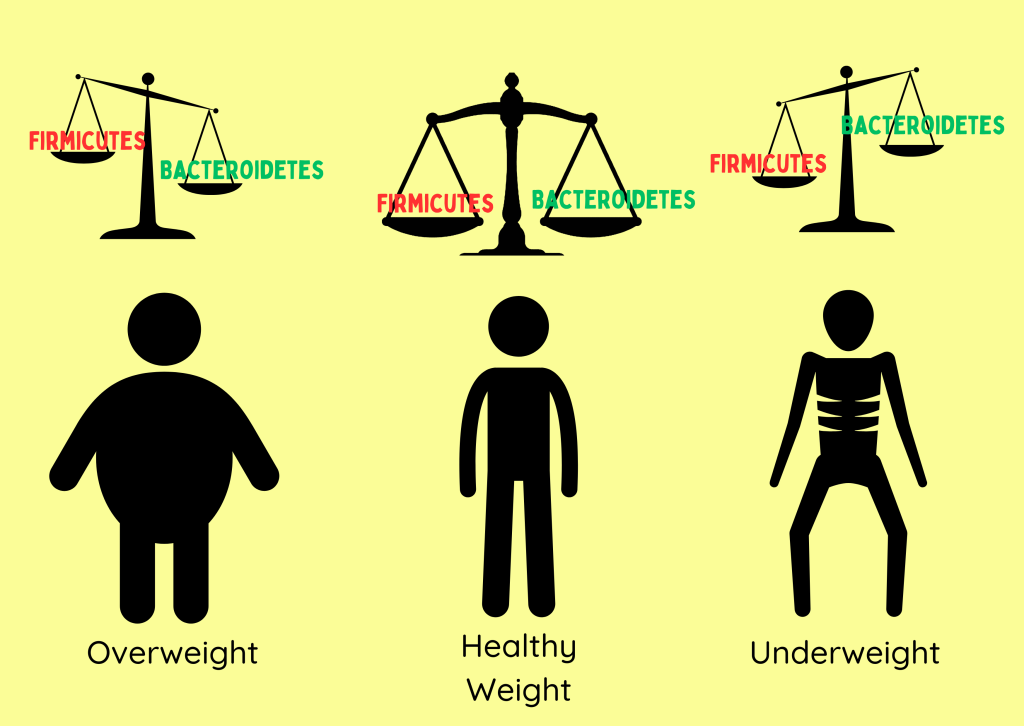
Two bacteria species which seem to play a significant role in weight gain and management are Firmicutes and Bacteroidetes. It has been found there are more Firmicutes to Bacteroidetes in overweight or obese people, and as they lose weight, the Bacteroidetes increase and the Firmicutes decrease. Firmicutes are considered more effective as an energy source than Bacteroidetes, promoting more efficient absorption of calories, which is good if you haven’t got too many Firmicutes.
I mentioned how the gut microbiome produces short-chain Fatty Acids (SCFAs). By doing this, the gut plays a significant role in energy metabolism: how well our bodies take energy from food. An unhealthy metabolism will lead to excess energy storage in the form of fat, usually leading to unwanted weight gain. To produce more SCFA, you need to consume more dietary fibre and resistant starches. Consuming at least 25g of fibre per day is recommended. Sadly, in Western society, the average daily fibre intake is only around 15g/day and mostly less than that. SCFAs increase insulin sensitivity, which reduces the risk of type 2 diabetes, promotes normal blood glucose levels, and has beneficial effects on body weight and lipid metabolism. It also affects satiety, which reduces the overconsumption of calories.
Probiotics have been shown to have health benefits, such as inhibiting fat accumulation and reducing inflammation and insulin resistance. A combination of dietary interventions and probiotics was shown to be effective in reducing total body fat, especially visceral fat, which is the fat that’s around the abdomen and causes the most health issues. It also increases the presence of beneficial gut microbes and decreases harmful ones. However, it is essential not to take any old probiotics. There are a lot of them out there with different strengths and strains. It’s always best to do some research depending on your health goals, check which strains would be most beneficial and ask your local pharmacy or health food store for advice before buying. For example, increasing your Bifidobacterium and Lactobacillus spp levels has been shown to decrease levels of the appetite hormone ghrelin, reducing food intake.
A great way to fully understand your gut jungle is to do a Microbiome test. These tests can be done at home, and once you get the results, you can see what you need to do to get your gut back into shape—which gets you back into shape!
References
1. Koutoukidis DA, Jebb SA, Zimmerman M, Otunla A, Henry JA, Ferrey A, et al. The association of weight loss with changes in the gut microbiota diversity, composition, and intestinal permeability: a systematic review and meta-analysis. Gut Microbes. 2022;14(1):2020068.
2. Arslan NÇ, Gündoğdu A, Tunali V, Topgül OH, Beyazgül D, Nalbantoğlu ÖU. Efficacy of AI-assisted personalized microbiome modulation by diet in functional constipation: a randomized controlled trial. Journal of Clinical Medicine. 2022;11(22):6612.
3. Koliada A, Syzenko G, Moseiko V, Budovska L, Puchkov K, Perederiy V, et al. Association between body mass index and Firmicutes/Bacteroidetes ratio in an adult Ukrainian population. BMC Microbiol. 2017;17(1):120.
4. Noor J, Chaudhry A, Batool S, Noor R, Fatima G. Exploring the Impact of the Gut Microbiome on Obesity and Weight Loss: A Review Article. Cureus. 2023;15(6):e40948.
5. Turnbaugh PJ, Ley RE, Mahowald MA, Magrini V, Mardis ER, Gordon JI. An obesity-associated gut microbiome with increased capacity for energy harvest. Nature. 2006;444(7122):1027-31.